2. When You Need It
Scheduled maintenance works best when it lands ahead of demand, not in the middle of it. Florida has two natural service windows, and the climate normals explain both.
The first window is ahead of summer. By late spring the system is about to face months of 90°F days. Tampa's first night below 60°F typically arrives around October 19, so the cooling season effectively runs from spring into autumn. A visit in the weeks before the heat settles in gives the coil, the drain and the electrical components a clean start to the season.
The second window is after the rainy season. June through September each bring more than 6 inches of rain, and August is the wettest month. Once the rain eases, it is worth checking what the wet months did: debris on the outdoor unit, a drain line that ran slowly through the storms, staining or moisture near the indoor unit, or a filter that clogged faster than expected.
The seasonal windows are a starting point. The right timing for a particular home depends on how the system has run, whether it has been serviced before, and what the homeowner has noticed.
Other triggers call for a visit whatever the season:
- Cooling output or airflow has slipped, such as rooms that take longer to cool or weak air at the registers.
- The condensate drain has overflowed, or water shows around the indoor unit.
- The system cycles oddly, short-cycling on and off or running much longer than usual.
- A storm season of heavy rain and debris has passed over the outdoor unit.
- The system has gone unvisited for a long stretch. A system that has run for seasons without a tune-up is a good candidate for a visit, even if nothing seems wrong yet.
Warranty terms vary. Check the manufacturer's own terms for any maintenance requirement that applies to your equipment, and keep a record of service visits regardless.
If any of these describe your system, call Prime Florida HVAC to describe what the system is doing. A short description of the symptoms helps decide whether a maintenance visit or a repair visit is the right first step.
3. How the Work Runs
Each visit follows the same sequence so the homeowner knows what was checked and why. The steps below describe the process. The exact scope depends on the system, its age and its condition. To book a visit, call Prime Florida HVAC today to arrange a time.
1. Booking and system history
The visit starts with what the homeowner reports: the age of the system if known, past repairs, and current behaviour such as weak airflow, humidity inside the house, unusual noise or a thermostat that seems slow. The technician also asks where the house feels warm or humid in summer and whether some rooms run hotter than others. Previous service records are useful. This conversation shapes what the technician looks at first.
2. Outdoor unit
The condenser is inspected for coil condition, and the coil is cleaned where needed. The fan and electrical components are checked. The technician confirms clearances around the unit and clears debris from the cabinet, the fan area and the ground around it. Clearances matter because restricted airflow around the condenser makes the system work harder.
3. Indoor unit
The air filter is checked and replaced if due. The evaporator coil, blower and air handler are inspected. The condensate drain line is cleared and tested, and the drain pan and float switch are checked. In Florida this is the step that matters most: a blocked drain in August humidity can become a water-damage event.
4. Refrigerant and performance checks
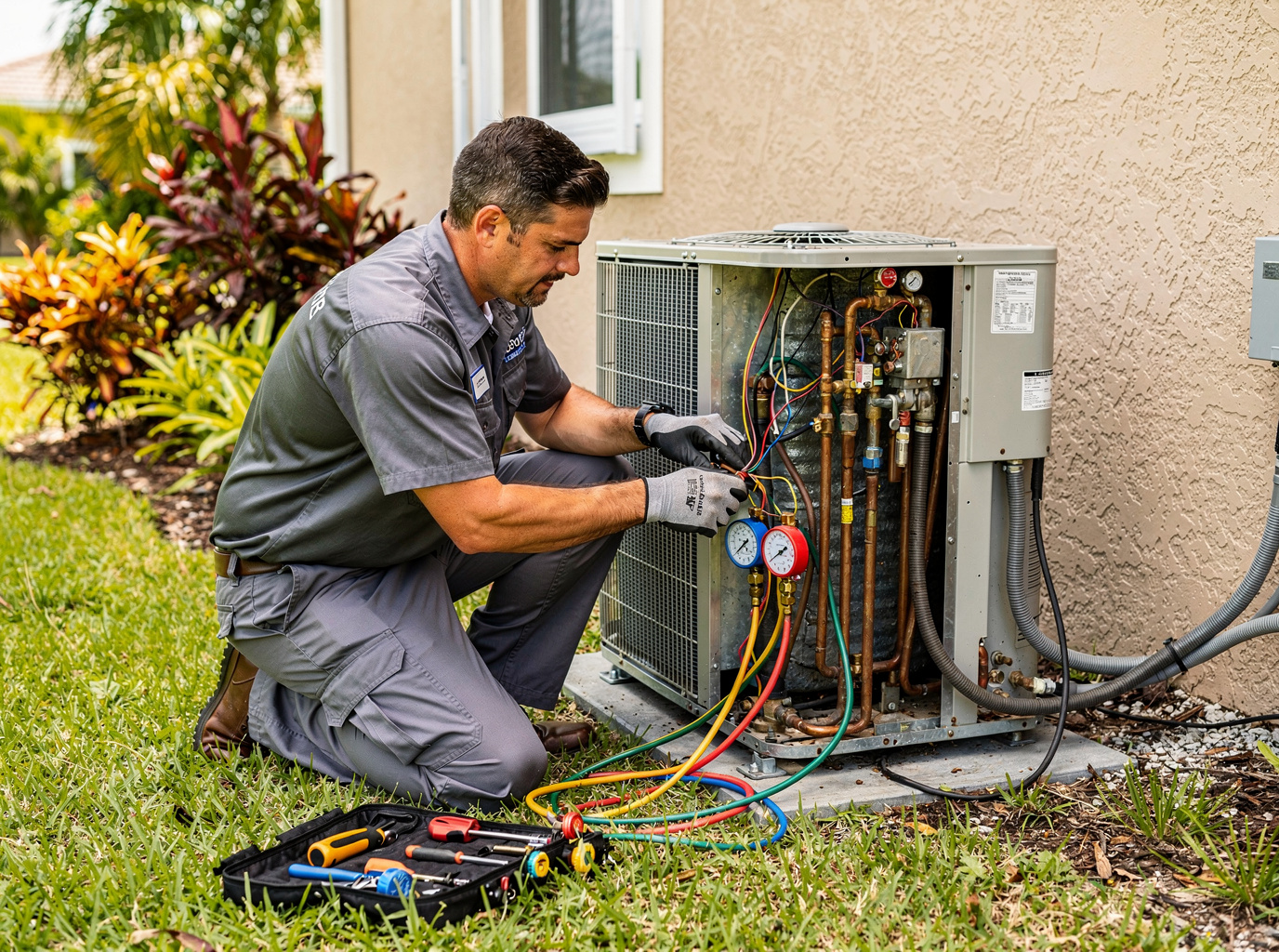
Pressures and temperatures are read and compared with expected behaviour for the system and conditions. The readings are recorded at the visit so the next visit can be compared against them. Controls and the thermostat are verified against the settings the homeowner wants. Settings that affect humidity, such as fan operation and temperature setpoints, are reviewed with the homeowner, because they change how much moisture the system removes. The system is then run through a full cycle so the technician can see how it starts, runs and shuts down.
5. Findings
Wear items are flagged honestly. Some findings need attention now, some are worth watching, and some are in good shape. No urgency is invented to make a finding sound bigger than it is, and no repair is sold inside this page. If a repair is needed, the air conditioning repair page explains how that work is handled.
6. Close-out
The work that was done is recorded for the homeowner, along with each finding and its priority. Next-visit timing is discussed in seasonal terms, such as ahead of the next summer or after the next rainy season.
4. What's Inside This Service
Three components of a maintenance visit decide how well a Florida system performs through the season.
Coils, filters and airflow
The evaporator coil sits inside the indoor unit and the condenser coil sits outside. Both move heat, and both collect dust, pollen and debris over time. When a coil is fouled, it cannot transfer heat as well, so the system runs longer to reach the same temperature. In a Tampa summer that also means less moisture comes off the air, which leaves the house feeling warm and clammy even when the thermostat says it is cool enough. A dirty filter restricts airflow across the same coil and makes the problem worse. Cleaning and filter replacement restore the surfaces and airflow the system was designed around. The work is needed whenever the coils look dirty, the filter is overdue, or the house feels humid despite the unit running. What drives the scope is the number of coils, the coil design and how much buildup has accumulated since the last visit.
Condensate drainage
When the system cools, it pulls moisture out of the air. That water collects in a drain pan and leaves through the condensate drain line. A float switch is designed to shut the system off if the pan fills, but only if it works. In Florida, June through September rainfall and indoor humidity keep water moving through this path for months at a time. A line partly blocked by algae or sludge can back up quietly, and a pan that overflows in August can soak a ceiling or closet before anyone notices. That makes the drain the highest-stakes check on the list. A visit clears the line, tests that water flows without obstruction, inspects the pan and confirms the float switch responds. The scope depends on how the drain is routed and how accessible the indoor unit is.
Electrical and refrigerant checks
Capacitors, contactors and refrigerant charge are among the wear items that turn into peak-season failures, because they fail under sustained heat and load. A capacitor gives the fan and compressor motors the push they need to start, and a weak one leaves them struggling under heat. A contactor switches the high-current path to the outdoor unit and can pit or stick over time. Refrigerant charge governs how well the coils absorb and release heat, and a slow leak can cut capacity long before the system fails outright. The visit tests the electrical components and reads refrigerant pressures and temperatures against the system's expected behaviour. What drives the scope is the equipment type, the number of components and what the readings show.
5. Maintenance and Tampa's Rules
A maintenance visit is a service appointment, and the City of Tampa's permit rules govern permitted work. Knowing where that line falls helps homeowners understand whether any paperwork is involved.
The City's mechanical permit exemptions are narrow. Under the City's Construction Services guidance, they cover portable heating, ventilation and cooling appliances, portable evaporative coolers, small self-contained refrigeration systems, and replacement of parts that do not alter a system's approval or make it unsafe. A maintenance visit that finds a fault whose repair stays within those exemptions does not, by itself, require a permit. Routine maintenance and repair are not permitted work per se, and the City's mechanical exemptions cover part replacements that do not alter a system's approval or make it unsafe.
Some findings lead to a different kind of project. A change-out, meaning replacement of the air conditioning system itself, is not a part swap. In Tampa, A/C change-outs run as Express Permit projects. They do not require plan review, but permitted work must be inspected and must receive final inspection approval. The installation page covers that process in full.
After an emergency repair, the City's guidance is that a permit application must be submitted within the next working business day. That rule belongs to the repair process, which is explained on the repair page.
The City's FAQ also states that contractors must be licensed by the State of Florida or hold a Hillsborough County local competency card. That is a framework a homeowner can check for any contractor they are considering. This page does not state any licence, permit or credential held by Prime Florida HVAC. Ask for the details directly, and verify them with the state or county.
Under a homeowner's permit, the homeowner cannot subcontract electrical, plumbing or mechanical work. Anyone planning a project beyond a routine visit should read the City's rules before work starts. Homes outside city limits follow the county permitting route, and Temple Terrace runs its own Building Department, so check the permitting route for your address first.
6. What AC Maintenance Costs Depend On
No price is listed here. The cost of a maintenance visit depends on the factors below, and the scope is confirmed before work begins.
System size and configuration. A single system with one outdoor unit and one indoor air handler takes less time than a home with multiple systems, zones or separate heat pumps. Each additional unit adds coils, drains, filters and controls to check.
Accessibility. An indoor unit in an open closet takes less time than one in a tight attic, a crawlspace or a space that requires moving stored items. Access affects how long the drain and electrical checks take.
Condition on arrival. A neglected system takes longer. Heavy coil buildup, a clogged drain, debris around the outdoor unit, or a filter that has not been changed in a long time all add work before the normal checks can begin. A clean, accessible system with light buildup takes less time than one with heavy coil fouling or a partly blocked drain, which sets much of the scope.
Wear items found during the visit. Some findings can be corrected at the same visit, by agreement with the homeowner. Others are noted for later. Whether a correction is made during the visit depends on what was found and what the homeowner agrees to.
The process is the most important part. What the visit covers is stated up front, and findings are reported before any further work is proposed. The homeowner decides what happens next. This page describes that process and makes no promise about the amount of any future work.
7. Questions People Ask
How long should an AC unit last in FL?
Service life depends on the conditions a system works in and the care it receives over the years. Florida adds heavy load: many days at 90°F or more, long stretches of humidity, and a rainy season that keeps coils and drains wet. Salt-laden coastal air can also speed corrosion on outdoor components, as general reasoning. What shortens life most is a heavy duty cycle, fouled coils, blocked drains, worn electrical parts and long periods without service. What protects it is regular coil cleaning, timely filter changes, prompt drain clearing and a maintenance history that catches small faults early on.
What does an AC tune-up actually check?
A tune-up covers the whole system. The outdoor coil is inspected and cleaned where needed, and the fan and electrical components are checked. Indoors, the filter, evaporator coil, blower and condensate drain are checked, and the drain line is cleared and tested. The technician reads refrigerant pressures and temperatures, verifies the thermostat and controls, and runs the system through a full cycle. Wear items are reported honestly, with what needs attention now and what to watch. The visit is for inspection and maintenance, and any repair is discussed separately.
How often should an AC be serviced in Florida?
Florida's cooling season is long. Tampa averages 94.3 days a year at 90°F or more, and June through September each bring more than 6 inches of rain. A practical rhythm is a visit ahead of summer and another after the rainy season, once the wet months have left debris, drain problems or wear. Systems that run hard, sit in dusty or shaded spots, or have a history of problems may need closer attention. The right interval depends on the system and its condition. Check the manufacturer's own terms for any service requirement that applies to your equipment.
Can maintenance prevent a blocked condensate drain?
Maintenance reduces the risk, although no visit can rule out every blockage. During a visit, the condensate drain line is cleared and tested so water flows without obstruction, the drain pan is inspected for rust or cracks, and the float switch is confirmed to respond. These checks catch the algae and sludge that can back up into the house. Between visits, keeping the area around the indoor unit clear and watching for standing water helps. Drain checks are the highest-stakes item during Tampa's humid months.
Call Prime Florida HVAC to book the visit once you have the answers you need.