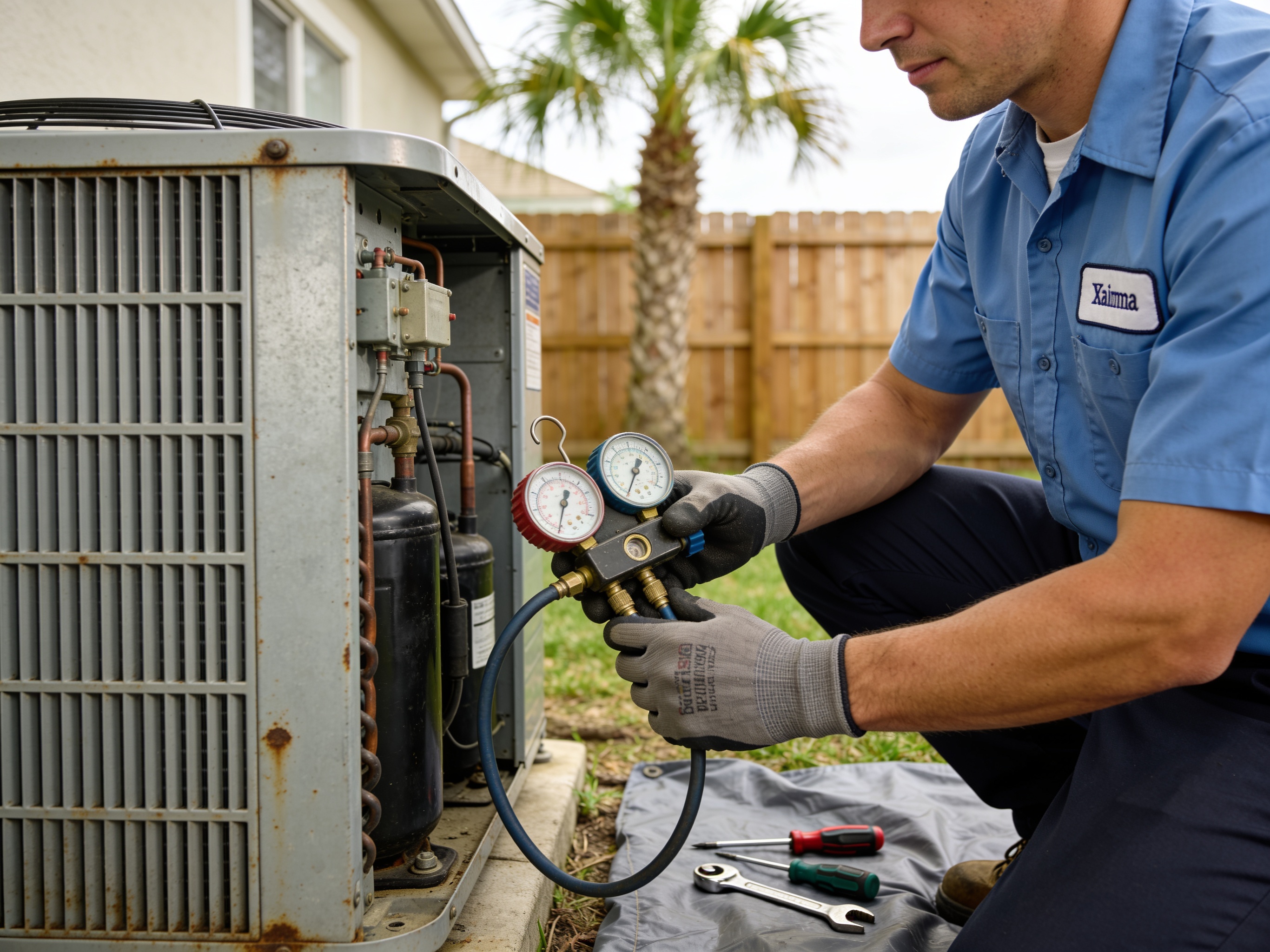
1. What Air Conditioning Repair Is
Repair means identifying the actual fault before anything is changed. A cooling system is a chain of connected parts: power and controls, the compressor and fan, the refrigerant circuit, the indoor coil and airflow, and the drain that carries away moisture. A fault in one link often shows up as a symptom in another. A weak fan can make a coil freeze. A failing capacitor can make a compressor overheat. A dirty filter can look like a refrigerant problem. Repair starts by separating these causes.
Common failure families are well understood in general terms. Electrical components such as run capacitors and contactors wear out and stop the outdoor unit or compressor from starting or running correctly. Refrigerant charge can fall because of a leak in the line set, the evaporator coil or a fitting. Condensate drainage can block, so water backs up at the indoor unit. Airflow can drop because of a dirty filter, a failing blower motor or a restriction in the ductwork. Thermostat and control faults can tell the system to stop, start or run at the wrong time. Each family produces different symptoms, which is why the first job is to tell them apart.
Tampa makes this work more pressing than it is in many places. Using NOAA National Centers for Environmental Information 1991 to 2020 normals for Tampa International Airport, the city averages 94.3 days a year with a high of 90°F or more. August is the wettest month at 9.03 inches, and June through September each average more than 6 inches of rain. In that climate a failed air conditioner is a habitability problem, not an inconvenience. Indoor temperature and humidity can climb quickly once the system stops removing heat and moisture from the home.
This page serves homeowners in Tampa and households across the surrounding service area whose air conditioning is not cooling properly, is not running, or is showing a warning sign that needs checking. It also serves property owners who want to understand what a proper repair involves before any decision is made.
If your system has stopped or is struggling, call Prime Florida HVAC to describe what the system is doing.
2. When You Need It
Some signs are clear enough that a visit should be arranged without delay. The system does not start when the thermostat calls for cooling. The system runs but the house does not cool down. Air from the vents is warm or weak. There is ice on the refrigerant lines or on the indoor coil. Water is collecting around the indoor unit or near the air handler. The system starts and stops in short bursts, which is called short-cycling. There are new noises, such as grinding, banging or buzzing, or a burning or electrical smell. A sudden rise in the electric bill is also worth investigating, since it can point to a system working harder than it should. That is a reason to check, not a figure to rely on.
Many problems can be reduced before a call by simple checks a homeowner can make safely. These are the same first checks that answer the most common question about a failing system, covered in the FAQ below:
- Thermostat: confirm it is set to cool, the set temperature is below the room temperature, and the fan setting is correct.
- Air filter: check whether it is clogged. A dirty filter restricts airflow and can cause a coil to freeze.
- Breaker and switch: check the breaker panel for a tripped breaker, and confirm the indoor and outdoor disconnects are on. Do not open electrical panels or the unit's electrical compartment.
- Outdoor unit: make sure the condenser is clear of leaves, debris, plants, and anything blocking airflow around it.
If these checks do not restore normal operation, or if the system shows any of the signs above after the checks, it is time to stop and call.
Urgency in Tampa follows from reasoning about the home. When the cooling system is dead, heat from the building envelope and from people, appliances and lighting continues to add up. Humidity also builds up because the system is no longer removing moisture. Over a long, hot, humid stretch, a home without working cooling can become uncomfortable, and moisture problems can start to develop inside the home. The longer a system sits dead in a Tampa summer, the more the home carries the load. That reasoning, not an exaggerated figure, is why waiting is rarely the cheaper option.
Call Prime Florida HVAC today to book the visit, especially if the system is showing more than one of these signs.
3. How the Work Runs
A repair visit follows a set sequence. Each step narrows the fault until the repair targets the real cause.
1. Call and description
The visit starts with the phone call. Describe what the system is doing in plain terms: whether it starts, whether it runs, whether the air is cold, warm or weak, whether there is water, ice, noise or smell, and when the problem began. Have ready the make and age of the system if known, the thermostat settings, and any checks already made. A clear description helps plan the visit and shows which parts of the system to check first.
Call Prime Florida HVAC to describe the symptoms and arrange the visit.
2. Diagnosis on site
On site, the technician starts with the controls and the power supply. Thermostat signals, safety switches, fuses, breakers and voltage are checked before anything else is opened up. Then the failure is isolated by testing rather than assumed. Electrical tests look at components such as capacitors, contactors and motors. Refrigerant tests look at pressures and charge, and they are followed by leak location where a leak is suspected. Airflow checks look at filters, blower operation and duct restriction. Drainage checks look at the condensate line and the pan. Each test rules a family of faults in or out, so the repair targets the actual fault.
3. Findings explained
Once the cause is known, the findings are explained in plain language. The explanation covers what failed, why it matters to the system, what the repair involves, and what it is likely to affect. It also covers the honest decision point. Some repairs are straightforward and sensible. In other cases the repair cost or system condition means that replacement becomes the more sensible conversation. For that conversation, see the installation page. Replacement is not pushed here. The homeowner should understand the options before any work proceeds.
4. The repair itself
The failed component or condition is corrected. Related strain points are checked at the same time, because parts rarely fail in isolation. A failed capacitor and a struggling motor are read together, since a motor that has been working against a weak capacitor may be worn out too. A refrigerant leak is repaired at its source rather than covered by adding refrigerant. A blocked drain is cleared and the drain path is checked for further problems. Where the repair touches the refrigerant circuit, the work follows handling practice for the refrigerant involved.
5. Verification
Before the job is closed, the system is run and checked. Cooling output, airflow at the supply registers, condensate drainage, and cycling behaviour are all confirmed. A repair is complete only when the whole system runs as it should, not when one part responds.
6. Close-out
The close-out explains what was done, what the homeowner should watch for in the days and weeks after the visit, and what to do if a symptom returns. It also explains how scheduled maintenance reduces repeat failures by catching worn parts, dirty coils, weak capacitors and drainage problems before they stop the system. For that, see air conditioning maintenance.
4. What's Inside This Service
Air conditioning faults fall into a small number of families. Each has its own symptoms, tests and cost drivers.
(a) Electrical and control faults
Electrical and control faults include capacitors, contactors, blower motors, thermostats and control boards. A weak capacitor often causes the compressor or fan to hum, struggle to start, or stop after running briefly. A failing contactor can leave the outdoor unit silent when the thermostat calls for cooling. A worn blower motor reduces airflow, which in turn can freeze the coil or overheat the system. Thermostat and control board faults can cause the system to ignore a call for cooling or to run at the wrong times. Each is tested, not guessed. Capacitors are checked against their rated values, contactors are tested for proper pull-in and electrical continuity, motors are checked for current draw and that they turn without resistance, and control signals are traced from the thermostat. What drives the cost is the component involved, how many related parts it has strained, and access.
(b) Refrigerant and coil problems
Refrigerant problems start with a loss of charge. A system that is low on refrigerant cools poorly, may ice the evaporator coil, and can run for long periods without reaching the set temperature. Adding refrigerant without finding the leak is a common mistake, not a repair. The refrigerant escapes again and the system can be damaged by running low. A proper repair finds the leak with pressure checks, joint inspection and suitable detection methods. The leak is then corrected at its source and the system is recharged to the correct amount. Frozen evaporator coils are a symptom of several problems, including low charge, poor airflow and a failing blower, so the coil is never treated on its own. Cost depends on where the leak is, how accessible the coil is, the refrigerant type and amount involved, and the age of the equipment.
(c) Airflow and condensate
Airflow and condensate faults are among the most common causes of AC trouble in a humid climate. Clogged filters restrict air across the coil, which leads to freezing, weak cooling and extra strain on the blower. Blower and duct-side restrictions, such as collapsed flex duct, closed or blocked registers, or dirty coils, reduce the air volume the system needs. Condensate drains carry away the coil's moisture. When a drain line blocks, the water can overflow the drain pan, stain ceilings, soak insulation, or damage flooring. In a Tampa home, a drain fault can go unnoticed until water damage has built up indoors. Repair means clearing the drain, checking the pan and float switch, correcting airflow, and confirming the drain runs clear. Cost depends on access to the drain, the extent of any secondary water damage, and the number of airflow problems found.
(d) Heat pump cooling faults
Heat pump cooling faults are a supporting category here. Some faults on heat pumps present as cooling problems, including faults in the reversing valve or defrost board. A reversing valve that sticks can leave the system unable to cool properly or send refrigerant the wrong way. A defrost board fault can leave the system in the wrong mode or cause frost to build up on the outdoor coil. These faults are tested with the same discipline as other cooling faults, but they need a heat pump's own sequence of checks. The full heat pump story, including heating operation, is covered on the heat pump services page. Cost depends on the component, its accessibility, and whether the fault has affected the rest of the system.
5. Permits and Repairs in Tampa
Most repairs do not need a permit. The City of Tampa's mechanical permit exemptions cover replacement of parts that do not alter a system's approval or make it unsafe. The same exemptions cover portable heating, ventilation and cooling appliances, portable evaporative coolers, and small self-contained refrigeration systems of 10 pounds of refrigerant or less with motors of 1 horsepower or less. A typical repair of a capacitor, contactor, motor, or drain component falls within what the City describes as the replacement of parts that do not alter approval or safety.
Where a repair crosses into replacing the system, the work becomes a change-out. The City treats air conditioning change-outs as Express Permit projects that do not require plan review. The installation page explains that route in detail.
Emergency repairs follow a separate rule. After an emergency repair where a permit is required, the City expects a permit application to be submitted within the next working business day. Permitted work must be inspected, and it must receive final inspection approval. These are the rules the property owner has to meet, and they apply whether the work is done by one contractor or another.
Prime Florida HVAC will explain which kind of work applies to your repair, and what the City's rules ask of you as the property owner. The business does not promise to file permits on your behalf, and this page does not describe any licence or credential held by the business. The City also states the contractor rule: contractors must be licensed by the State of Florida or hold a Hillsborough County local competency card. That is a rule any homeowner can check for the contractor they hire. Under a homeowner's permit, the homeowner cannot subcontract electrical, plumbing or mechanical work.
Tampa is a City with its own construction services department, so the route is the City's, not the county's. Homes in the surrounding suburbs run through their own jurisdiction. If you are not sure which route applies to your address, ask before the work starts.
6. What AC Repair Costs Depend On
No single price applies to every repair. The cost of an AC repair depends on a set of factors that the diagnosis reveals.
- Which component failed. A capacitor, a contactor, a blower motor, a control board, and a refrigerant leak each involve different parts, labour and testing.
- Whether the fault is isolated or has strained other parts. A failed part that has overworked a motor, a compressor or a coil usually needs more work than the original fault alone.
- Refrigerant type and amount. Where a leak is repaired, the refrigerant involved and the amount needed to recharge the system both affect the work.
- System age and parts availability. Older equipment may need parts that are harder to source, and that affects both time and the decision about repair.
- Access. An air handler in an attic or a tight closet, or a condenser at roof level, takes more time and care to reach than equipment at ground level.
- Secondary damage. Drainage or airflow faults can cause water damage, stressed ductwork, or frozen coils. Those effects are part of the scope.
- Permit scope. Whether a permit applies depends on whether the work replaces parts or replaces the whole system, which is why the route in the permits section above is checked before the scope is closed.
The diagnosis comes first. The fault is identified, the scope is explained, and the homeowner understands the options before repair work proceeds. That order is the process, and it is the reason a visit starts with testing rather than with a guess at the fault.
7. Questions People Ask
What is the first thing to check when the AC stops working?
Start with the simple checks a homeowner can make safely. Confirm the thermostat is set to cool, with the set temperature below room temperature and the fan set correctly. Check the air filter and replace it if clogged. Look at the breaker panel for a tripped breaker and make sure the indoor and outdoor disconnects are on. Confirm the outdoor unit is clear of leaves, debris and anything blocking airflow. If the system still does not start, runs without cooling, or shows ice, water or unusual noise, stop and call Prime Florida HVAC to arrange the visit.
Can a refrigerant leak be repaired, or does the system have to be replaced?
In most cases a leak can be repaired, but the answer depends on where it is and what condition the system is in. The technician locates the leak with pressure checks and inspection, then corrects it at its source before recharging to the correct amount. Refrigerant that is simply added without finding the leak is not a repair. The leak location, the condition of the coil and line set, the age of the equipment, and whether parts are available all decide the next step. If the repair would be a poor use of money, the findings will say so.
Do I need a permit for an AC repair in Tampa?
Most repairs do not need a permit. The City of Tampa exempts replacement of parts that do not alter a system's approval or make it unsafe, along with portable appliances and small self-contained refrigeration. If a repair crosses into replacing the system, it becomes a change-out, which the City handles as an Express Permit project without plan review. After an emergency repair where a permit is required, the application is due within the next working business day, and permitted work must pass final inspection. The rules fall on the property owner, so ask the technician to explain which route applies.
My AC runs but does not cool. What are the likely causes?
A system that runs without cooling is showing a symptom, and several causes can produce it. Restricted airflow from a dirty filter, a failing blower, or a blocked duct can stop the coil from removing heat. A low refrigerant charge caused by a leak can leave the system unable to cool properly. A failing capacitor, contactor, or compressor can also reduce output while the system still runs. These are possibilities, not conclusions. Only an on-site diagnosis can separate them, because the same symptom can come from more than one family of faults.