2. When You Need It
Some situations point toward indoor air quality work. None of them is a diagnosis on its own, but each one is a reason to check how the system handles filtration and humidity:
- A musty smell that appears when the system runs, especially after it has been off for a while.
- Visible dust build-up on surfaces that returns quickly after cleaning.
- Indoor air that feels clammy even when the thermostat shows the set temperature is being reached.
- Condensation on windows, door frames or supply grilles.
- A home that has had a water intrusion event and still smells of it. This is treated here as a moisture issue to control inside the HVAC system, not as a remediation job.
The reasoning behind these signs is simple. In a sealed, air-conditioned Florida home, humidity is the root variable. Air that holds more moisture than the house is designed to remove produces the clammy feel, the condensation and the smells. Filtration decides how much dust and debris the air carries past the rooms. Ventilation decides how much fresh air enters a house that is otherwise tightly closed. Humidity that lingers after the system runs, together with dust that returns quickly after cleaning, usually points to a system-level cause rather than a single part, so the assessment looks at filtration, humidity and airflow together. Once humidity is understood, the rest of the picture usually follows.
Some homes raise these signs at the same time as a cooling fault. If the system is also failing to cool properly, start with the diagnosis on the air conditioning repair page. Indoor air quality work is best planned once the system is running correctly, so that changes to filtration or humidity handling are tested against a working system.
A homeowner does not need a long list of symptoms to ask for a check. A single persistent sign that does not go away after normal cleaning and routine upkeep is enough reason to describe the problem.
Call Prime Florida HVAC to describe what the house is doing, such as when the smell appears or which rooms feel damp, so the conversation starts with real detail.
3. How the Work Runs
1. Assessment
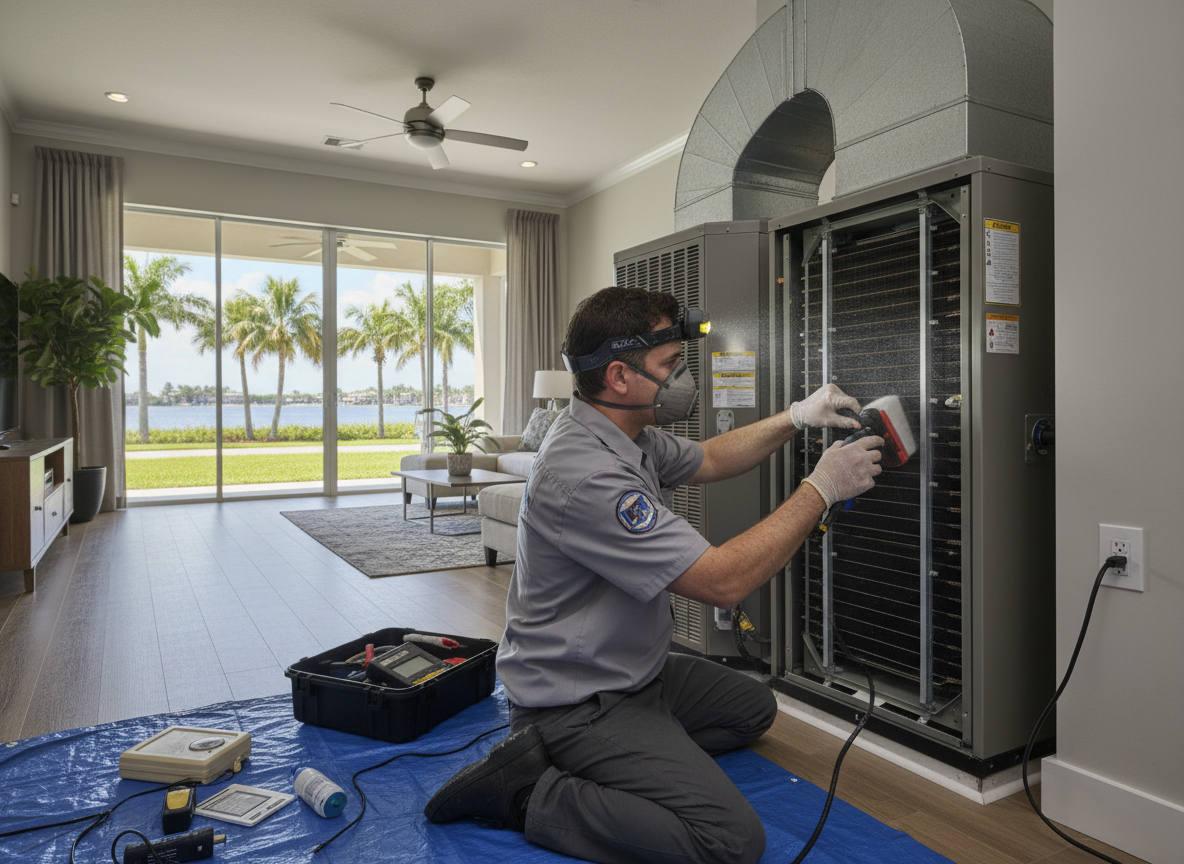
The first visit looks at the existing system as it is installed. This covers the air handler, the filter set-up, the ductwork as far as it can be seen, and the controls. Humidity is observed across a day, not from one reading. Humidity readings are taken at several points in the day, and the pattern is discussed with the homeowner rather than judged from a single snapshot. The talk covers when the house feels damp and how the system responds. The aim is to understand how the home behaves in real conditions before any equipment is suggested.
2. Findings
The assessment identifies which of the three levers the home actually needs: filtration, dehumidification, or ventilation. It also identifies which ones it does not need. Some homes need one lever, some need several, and some are already adequately set up. The findings are discussed plainly, and a lever the assessment does not support is not sold. A lever that is not needed is ruled out on the evidence, and the reason is given to the homeowner. That is part of the process, not a gap in it.
3. Fitting
Selected equipment is integrated with the existing air handler and its controls. The work is planned so that the system's airflow, drainage and controls are considered at the same time as the new equipment. The equipment is wired into the air handler's control circuit, and it is set to respond to the thermostat and humidity setting together, against the blower's run times. If the home needs an adjustment to the ductwork or electrical supply to make the equipment work, that is identified before fitting begins.
4. Verification
After fitting, humidity and system behaviour are checked again. The aim is to confirm that the equipment behaves as the findings predicted, and to note any settings that need adjusting. Readings are compared with the figures recorded at assessment, and the blower's run pattern is checked against the expected cycle. The controls are explained so the homeowner knows what each setting does and when to change it.
5. Close-out
The close-out sets out the filter and maintenance rhythm for the new set-up. Filter checks, drain checks and controls checks are scheduled around the system's real use. The routine is explained in writing so the homeowner can keep it going. Ongoing system checks are covered on the air conditioning maintenance page.
Call Prime Florida HVAC to arrange an assessment visit and to ask how the process would apply to the home's current system.
4. What's Inside This Service
This service fits four equipment categories to the existing system: filtration, whole-home dehumidification, ventilation, and UV and air treatment options.
Filtration
Filters are a ladder of what they physically catch. Finer media catches smaller particles, and the densest media catches the finest material. The rating describes that capture ability and is a useful way to compare options. A higher rating does not automatically mean a better result for a given system.
The trade-off is airflow. Dense media resists air moving through it. If the system cannot handle that resistance, the blower works harder, airflow across the coil drops, and comfort suffers. The system is checked before a denser filter is fitted, and the assessment confirms the air handler can move air through the chosen media.
When filtration is upgraded, the change is treated as part of the whole air system, not as a single part swap. The filter class selected and any rack or housing changes a higher class needs both affect the cost.
Whole-Home Dehumidification
An air conditioner removes humidity as a side effect of cooling. On mild, wet Florida days, the system can reach the set temperature after a short run and shut off. The air may be cool but still humid, because the coil has not run long enough to dry it. That is why a home can feel clammy even at the set temperature.
A dedicated whole-home dehumidifier works with the system to remove moisture from the air as it moves through the ducts. It runs on its own schedule and does not rely on the cooling cycle. The assessment checks how the home behaves across a day before choosing this lever. The capacity the home's moisture load needs and the drainage route the unit ties into both set the cost.
Call Prime Florida HVAC to describe when the house feels damp, since that pattern guides the choice.
Ventilation
Tightly sealed homes need a controlled supply of fresh air. Without it, indoor air can stay recirculated and carry more moisture and more dust than the home needs. Controlled ventilation brings in outside air at a set rate, usually with the air handler's help, so the intake is managed rather than left to chance.
Opening a window is not a Florida summer strategy. Outdoor air in Tampa is typically hot and humid in summer, and opening the house brings that load straight into the cooled space. A controlled intake is a process choice, sized to the home and set up with the system's controls. Its rate is reviewed at the verification visit. The intake route and any duct or control changes the home needs add to the cost.
UV and Air Treatment Options
UV and other air treatment units are equipment categories that can be fitted in the air handler. They are described here only as options. A unit is fitted either at the coil or in the airstream, and it acts on the air and surfaces passing through the treated zone.
Treatment applies only to what passes through the unit, so it is not a whole-home guarantee. It does not replace filtration, humidity control or maintenance. Lamp replacement is part of owning the unit. A coil-side or airstream treatment is considered only when the assessment shows that it fits the home's set-up.
The cost depends on the home's system, the equipment class selected, and any changes the existing set-up needs. The unit class and its fitting position, at the coil or in the airstream, also set the cost.
5. IAQ Work and Tampa's Rules
Indoor air quality equipment is fitted to or into a home's mechanical system. Where the work alters that system, it follows the City of Tampa's mechanical permit rules. The City's mechanical permit exemptions cover portable appliances and the replacement of parts that do not alter a system's approval or safety. Work that falls outside those exemptions needs a permit, and permitted work must be inspected and receive final inspection approval. The test is whether the planned work alters the system's approval or safety, and that test is applied to each home before any equipment is chosen, not after it is on site.
Where a permit applies, the inspection is part of the planned sequence, and the work is not complete until final inspection approval has been received. The approval is worth keeping with the home's records, since it confirms the permitted work was reviewed by the inspecting department.
Homes in unincorporated Hillsborough County, including Brandon, Riverview, Valrico, Lutz and Seffner, go through Hillsborough County Development Services for permits and inspections. Temple Terrace runs its own Building Department, so homes there use that department rather than County Development Services. Which route applies depends on where the home sits. The route matters before any work is scheduled, because it decides which department inspects the work. Before a permit is planned, the address is checked against the boundary to confirm the route.
The contractor licensing framework is set by the State of Florida and Hillsborough County. A homeowner can verify that rule for any contractor. The framework runs through a state licence or a county competency card, and asking to see the relevant one before work starts is a reasonable check. It is not a statement of licences held by this business.
Call Prime Florida HVAC to ask which permit route applies to the address before any work is planned.
6. What IAQ Work Costs Depend On
The cost of indoor air quality work depends on factors, and these factors are the same whichever lever the home needs.
- Which levers the home needs. A home that needs filtration alone costs differently from one that needs filtration, dehumidification and ventilation together. One lever keeps the scope narrow, while several levers mean the fitting and controls work is planned together.
- System compatibility. The existing air handler, ductwork and controls determine what can be fitted without changes. Where duct or electrical adjustments are needed, they add to the scope of work. Those adjustments are identified before fitting begins, so they are not discovered partway through the job.
- Equipment class. Filtration media, dehumidifier capacity, ventilation controls and air treatment units each come in different classes, and the class selected affects the total. A higher class changes both the equipment and the fitting work around it.
The assessment is what turns these factors into a plan for a specific home. It sequences them in a fixed order: first the levers the findings support, then what the existing system can take without changes, then the equipment class that fits that set-up. Each step narrows the next, so the class is chosen last, once the scope is known. Recommendations follow the findings. Sometimes the finding is that the current set-up is adequate, and that is the honest recommendation when it is true. No cost is promised before the assessment has been done.
Call Prime Florida HVAC to describe the home's system and the goals for its air, so the factors can be weighed for that home.
7. Questions People Ask
Why does my home feel humid even when the AC is running?
An air conditioner removes humidity while it cools, but the removal depends on the coil running for a long enough period. On mild, wet days in Florida, the system can reach the thermostat's set temperature after a short run and then switch off. The air is cool but still holds moisture. A whole-home dehumidifier can manage humidity on its own schedule, so the air stays drier without relying on the cooling cycle alone. The assessment checks this first.
Is a higher-rated filter always better?
No. A denser filter catches finer particles, but it also resists airflow. A higher class can restrict airflow on a system not set up for it. If the air handler cannot move enough air through a dense filter, the blower works harder, airflow across the coil drops, and comfort can suffer. The system should be checked before a denser filter is fitted, so the filter chosen matches what the system can handle.
What is the difference between the AC's own dehumidifying and a whole-home dehumidifier?
An air conditioner removes humidity only while it runs its cooling cycle, and that removal is a side effect of cooling. A whole-home dehumidifier works with the system to remove moisture from the air as it moves through the ducts, and it can run to manage humidity even when the cooling is not needed. The unit is sized to the home's moisture load, which the assessment establishes. The two work together. The assessment decides whether a dedicated unit is needed.
Does indoor air quality work require a permit in Tampa?
It can. Indoor air quality equipment fitted to or into the mechanical system follows the City of Tampa's mechanical permit rules where the work alters the system. Replacing parts that do not alter a system's approval or safety falls within the City's exemptions. Permitted work must be inspected and receive final inspection approval. Homes outside the City of Tampa follow their own local route.
Call Prime Florida HVAC to ask which rules apply to the planned work at the home's address.