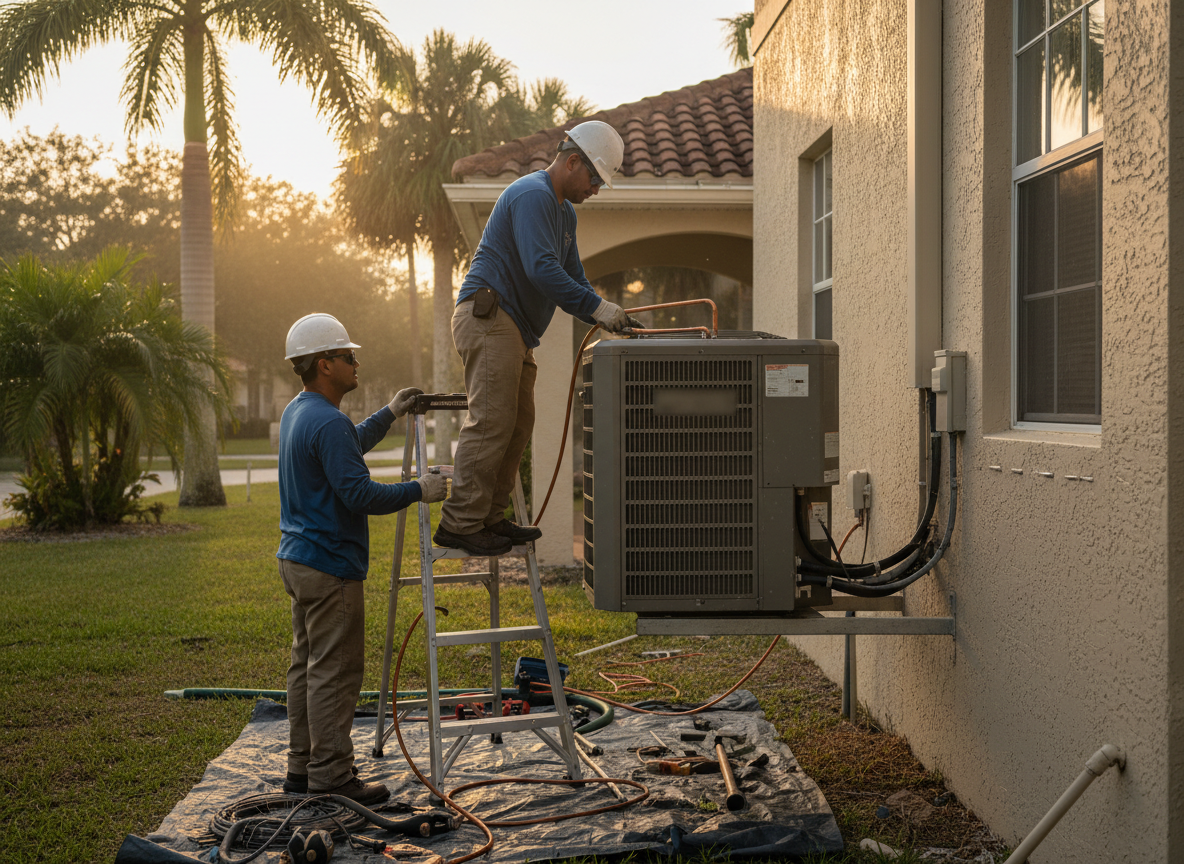
Heating and Cooling in Tampa
Prime Florida HVAC helps Tampa homes with AC repair in Tampa, FL, heating and cooling from our base at 3816 N Arlington Ave, Tampa, FL 33603. If an air conditioner has stopped, a heat pump is not keeping rooms comfortable, or a home needs a system that suits its layout, call Prime Florida HVAC to describe what the system is doing.
Tampa is a city of 413,554 people, according to the U.S. Census Bureau's July 1, 2025 estimate. Its cooling season runs for most of the year. Its heating season is a few mild weeks in winter. That imbalance shapes most HVAC decisions made here, from the system type that suits a home to the moment a fault is most likely to show up. The heating side is a separate story, covered in the next section.
This page covers the city itself: its climate, its housing, and the permit route that applies to HVAC work depending on where a property sits. Tampa is the city we serve from, and the local facts here shape its HVAC year. The service pages go into repair, installation, maintenance and comfort work in detail. Because a home a few miles away can fall under a different permit authority, this page sets out how each one works.
Tampa homes spend much of the year with the air conditioner or heat pump doing real work, so small faults matter. A dirty filter, a weak capacitor or a drain line that has begun to slow rarely stays small through a Tampa summer. Waiting for a complete breakdown often means the visit falls in the hottest weeks of the year. If the system has started to fail or sound wrong, call Prime Florida HVAC today to book the visit.
What Tampa's Climate Does to HVAC Systems
Tampa's climate sets the load on every system in the city. At Tampa International Airport, the NOAA 1991-2020 normals show 94.3 days a year at 90°F or more. July and August both average highs of 91°F or above, with lows around 77°F. An air conditioner in that pattern runs long hours with little overnight relief, and the outdoor condenser, compressor and capacitor carry that workload every day.
Rain adds a second pressure. June, July, August and September each average more than 6 inches of rain, and August is the wettest month at 9.03 inches. The evaporator coil pulls moisture out of indoor air, and that water has to leave through the condensate drain line. When the drain runs slowly, the coil stays wet, dirt builds on it, and airflow drops. Heavy wet-season loads make these faults more likely to show up as weak cooling than as a dramatic breakdown.
The same load shapes how long equipment lasts. Compressors, capacitors and blower motors that run for many hours in heat and humidity wear faster than the same parts in a milder place. What the climate does tell a Tampa owner is which parts take the most work, and where to look first when something changes. Drainage faults show this most clearly: June through September each average more than 6 inches of rain, and a slow condensate drain is the first thing to check.
Heating is the honest counterpart. The same normals show January with an average high of 71.3°F and an average low of 52.8°F. The average first night below 60°F arrives on October 19, according to NWS Tampa Bay. The heating season is short, and that is exactly why idle faults surface. A heat strip or reversing valve that has sat unused through the summer may first be tested on the first cold morning of the year.
What This Business Does in Tampa
Prime Florida HVAC works on air conditioning, heating, heat pumps, ductless systems and indoor air quality from our base at 3816 N Arlington Ave, Tampa. The links below lead to the service pages, where each job is explained in full. This is the short version.
- Air Conditioning Repair: diagnosis and repair of a central air system that has stopped cooling or is running poorly, explained under air conditioning repair.
- Air Conditioning Installation: replacement and new installation, covering system sizing, equipment choice and the permit steps, as laid out on the air conditioning installation page.
- Air Conditioning Maintenance: scheduled tune-ups that check the system before the hot months and catch small faults early, detailed under air conditioning maintenance.
- Heating Repair: repair of heat pump auxiliary heat, furnace or electric heat during Tampa's short heating season, explained under heating repair.
- Heating Installation: installation or replacement of a heating system in a home, explained under heating installation.
- Heat Pump Services: repair, maintenance and replacement of heat pumps, which provide both heating and cooling, covered on the heat pump services page.
- Ductless Mini-Split Systems: ductless systems for additions, garages, converted spaces and homes without ductwork, explained under ductless mini-split systems.
- Indoor Air Quality Services: filtration, humidity control and ventilation for Tampa homes, explained under indoor air quality services.
A homeowner who is not sure which service fits can start with the symptom: a room that will not cool, a system that runs without reaching the set temperature, or a heat pump that struggles on a cold morning. Then call Prime Florida HVAC to describe what the system is doing, and the right service page will be the one that matches it.
Tampa Local Facts
The Change-Out Permit Route
The City of Tampa handles air conditioner change-outs through its Express Permit route. The City's Construction Services FAQ lists A/C change-outs, water heater replacement and roofing as projects that do not require plan review. The permit still matters. Permitted work must be inspected and must receive final inspection approval.
For a Tampa property owner, a replacement is not finished when the old unit comes out and the new one runs. The paperwork closes only when the final inspection is approved. A reasonable homeowner question is simple: which permit covers this work, and when is the final inspection?
In practice, the route is faster than a full plan review, but it does not skip the inspection. The rule applies within the city's limits, which is why the next block matters. Anyone quoting a change-out should be able to explain how the permit is handled and what the inspection covers.
The Climate by the Numbers
The NOAA 1991-2020 normals for Tampa International Airport (station USW00012842) are this city's working HVAC year.
Cooling dominates. Tampa averages 94.3 days a year at 90°F or more. July averages a 91.0°F high and a 76.6°F low. August averages a 91.2°F high and a 76.8°F low, and it is the wettest month at 9.03 inches of rain. June through September each average more than 6 inches. January averages a 71.3°F high and a 52.8°F low.
For a property owner, these numbers set the sizing and timing questions. A system must handle a long cooling load, and maintenance is best scheduled before the hot months rather than after the first failure. The heating side is short, so heating faults often wait for the first cold stretch to appear.
A Renter-Heavy Housing City
Census QuickFacts puts Tampa's owner-occupied rate at 50.3% across 166,278 households. That leaves about half of the city's households living in homes they do not own. The average household has 2.31 persons, and 13.7% of residents are aged 65 or over.
That mix changes who arranges HVAC work. The occupant often notices the problem first, because the room is hot or the air feels wrong. The owner decides whether a unit is repaired or replaced. A property manager may arrange the visit. With a near-even split, the occupant, owner and manager are often different people, so the first call may come from whoever is in the room. The point is simply that more than one party may be involved in the same job, and each one needs to know what the permit route requires.
Three Permit Routes From One Address
This page states three permit routes because a Tampa address does not always fall under Tampa's permit authority. The City of Tampa runs its own Construction Services. Temple Terrace, a separate city in the same county, runs its own Building Department and does not route permits through Tampa or Hillsborough County. Unincorporated Hillsborough County, including Brandon, Riverview, Valrico and Seffner, runs through Hillsborough County Development Services.
The three routes are never merged. The Express Permit label belongs to the City of Tampa only. A Temple Terrace address uses that city's own email or over-the-counter AC replacement permit. An unincorporated address uses county permitting and Florida Building Code enforcement.
In practice, an owner should confirm the jurisdiction before assuming a route. Mixing the three would send a homeowner to the wrong office or the wrong form.
Permits and Paperwork for HVAC Work in Tampa
Inside Tampa's city limits, the City of Tampa Construction Services FAQ sets out how mechanical work is handled. The points below come from that FAQ.
Express Permit change-outs. A/C change-outs are Express Permit projects that do not require plan review. The City's own examples of this route also include water heater replacement and roofing.
Narrow mechanical exemptions. Some HVAC work is exempt from permit. The exemptions cover portable heating, ventilation and cooling appliances, portable evaporative coolers, small self-contained refrigeration systems of 10 lb of refrigerant or less with motors of 1 hp or less, and replacement of parts that do not alter a system's approval or make it unsafe. That part-replacement line keeps a like-for-like part swap outside the permit system, while anything changing the system's approval follows the permitted route. These exemptions are narrow, so check before assuming a job falls under one.
Emergency repairs. Where an emergency repair requires a permit, the permit application must be submitted within the next working business day after the repair.
Inspection and final approval. Permitted work must be inspected and must receive final inspection approval. A permitted job is not complete on the paperwork side until that approval is recorded.
Who may do the work. Contractors must be licensed by the State of Florida or hold a Hillsborough County local competency card. Under a homeowner's permit, the homeowner cannot subcontract electrical, plumbing or mechanical work. Homeowners can check a contractor's license or competency card before work begins. This is the framework a homeowner can verify for any contractor in Tampa. It is not a statement about the credentials of any one company.
This section explains the process. It does not promise that Prime Florida HVAC files permits for any job.
Calling From Tampa
Prime Florida HVAC is based in Tampa at 3816 N Arlington Ave, Tampa, FL 33603. The business is in the city, so the local permit and climate facts on this page apply to the work we do here.
To talk through a problem or arrange a visit, call Prime Florida HVAC. Before calling, it helps to have these details ready:
- What the system is doing: no cooling, weak airflow, water near the indoor unit, a loud noise, or a heat pump that struggles on cold mornings.
- The system type: central air conditioning, heat pump, furnace, ductless mini-split, or a system you are not sure about.
- Where the units sit: the outdoor condenser, the indoor air handler, and any wall units. Note whether they sit in an attic, a closet or outdoors.
- The property address: this shows which permit route applies, whether that is the City of Tampa, Temple Terrace, or unincorporated Hillsborough County.
Having these details ready makes the first conversation more useful for both sides.
Frequently Asked Questions About HVAC in Tampa
Do I need a permit to replace my air conditioner in Tampa?
If the home is inside Tampa's city limits, an air conditioner change-out is an Express Permit project, and the City of Tampa does not require plan review for it. The permitted work must still be inspected and must receive final inspection approval. A replacement is not finished until that final inspection approval is recorded on the permit. A home outside the city limits follows a different route, covered in the third answer below.
What is an Express Permit, and which HVAC projects use it?
Express Permit is the City of Tampa route for projects that do not require plan review. The City's Construction Services FAQ names A/C change-outs as an example, along with water heater replacement and roofing. It is the route the City names for those project types. Other HVAC work may follow different rules, and the mechanical exemptions are narrow.
My home is outside Tampa's city limits. Whose permit rules apply?
It depends on where the home sits. Temple Terrace is a separate city with its own Building Department, and AC replacement there is an email or over-the-counter permit type. Unincorporated areas such as Brandon, Riverview, Valrico and Seffner run through Hillsborough County Development Services, which issues building permits and enforces the Florida Building Code. The Express Permit label belongs only to the City of Tampa. Confirm the jurisdiction before assuming a route.
When does heating season actually start in Tampa?
Tampa does not have a fixed start date for heating season. The NOAA 1991-2020 normals show a January average low of 52.8°F and a January average high of 71.3°F. The average first night below 60°F falls on October 19, according to NWS Tampa Bay. The season is short, so heat is needed for only a few mild weeks. Faults in heat strips or a heat pump's heating mode often first appear on the first cold stretch of the year.